A way back from everything
An agent that acts on your Mac will sometimes act on the wrong thing. It will misread a request, or read it right and still be wrong about what you meant. We can make that rarer. We can’t make it never. So the design starts from the other end: every change Brello makes has a way back, and anything that can’t be undone is named before you say yes.
None of this is left to the model. Each tool Brello has is given a risk tier in code, the kernel’s gate asks by the tier, and Undo is a record the kernel writes as each step runs.
Five tiers, in code
| Tier | What it covers | What happens |
|---|---|---|
| Read | Listing, searching, reading, measuring | Runs at once |
| Reversible change | Making a folder, moving, renaming, copying, writing a new file, changing a setting | Runs at once, journaled for Undo |
| Destructive | Deleting, overwriting, changing many files at once, quitting an app, sleep and restart, emptying the Trash | Shown and asked first |
| Outward | Anything that speaks for you or sends your words to someone else | Always asked, with the exact words shown |
| Forbidden | Credentials, security settings, macOS’s own folders as targets | Refused |
Moving and copying into a folder you named run without a question, because the plan names each item and Undo puts each back. Setting files aside, or writing a file whose name you didn’t give, asks first.
One question for the whole plan
Before any step runs, every step that changes something is previewed. If any of them needs a yes, the gate asks once, for the whole plan, and the question lists exactly what will change: each item by name, with its picture and its size.
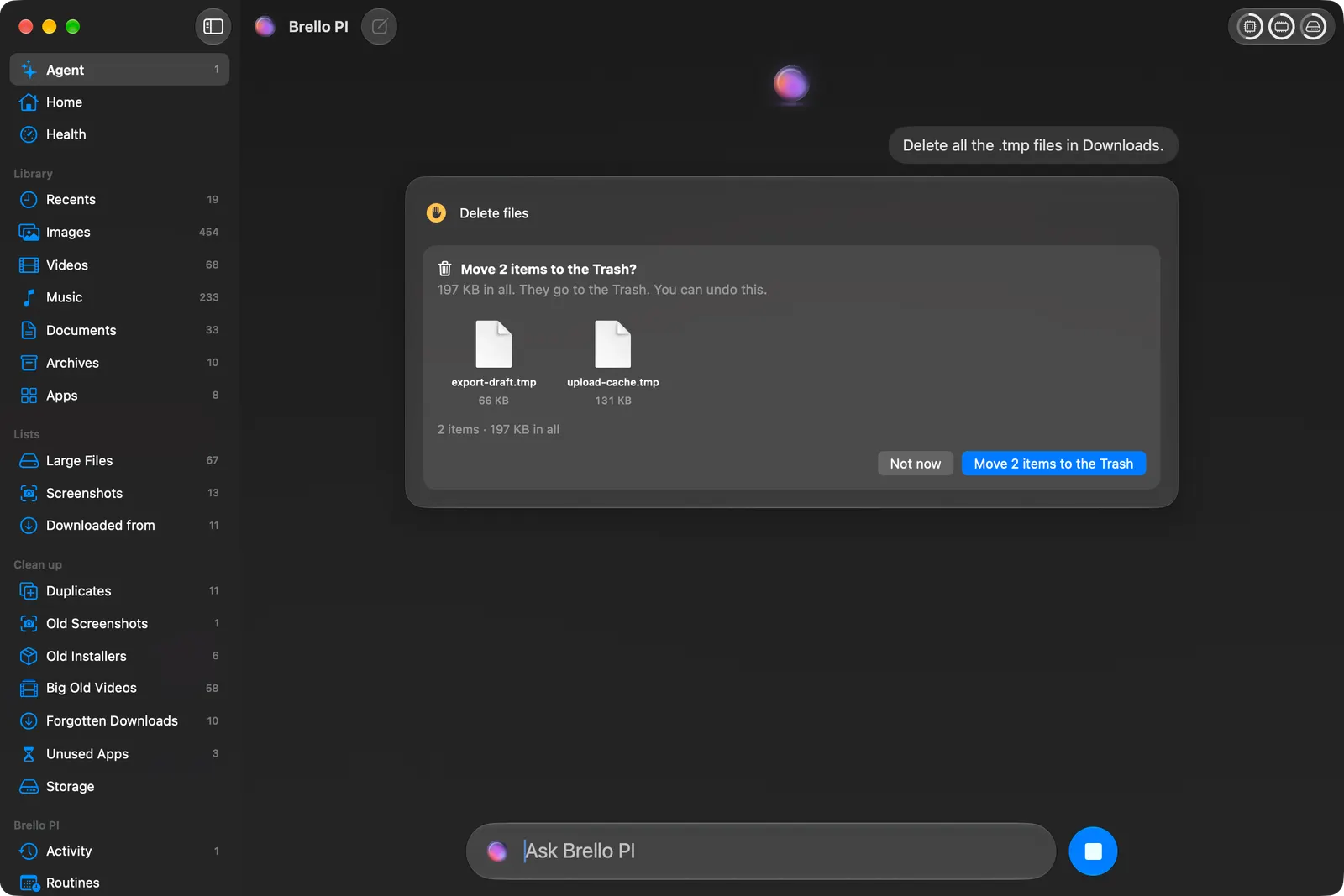
A yes covers what was shown and nothing more: each step is looked at again after the yes, and one that would now do something different doesn’t run. A no changes nothing at all. And when nobody is at the Mac, during a routine or a Shortcuts automation, nothing is asked, so nothing that needs a yes is done: no file is deleted, nothing is sent, nothing goes online. The answer says what is waiting for you.
Into the Trash, and back
Brello doesn’t delete your files outright. What it deletes goes to your Mac’s Trash, just as Finder moves it there, and you can watch it fly into the Trash in your Dock. Undo, or ⌘Z, brings it back to where it was, as long as it is still in the Trash.
A few things can’t come back, and Brello says so in the question, not after. Emptying the Trash deletes for good, so its question says how many items and how much. Sleeping, restarting, shutting down and logging out are acts, not changes, and nothing undoes them. All of these are destructive, so all of them ask first, and none runs with nobody at the Mac.
Undo, checked
As each step runs, the kernel writes how to put it back: the file’s old place and name, the folder it made, the setting’s value before. The journal is kept on disk, so Undo works after Brello PI quits and opens again. Each part of Brello PI that changes something has its own way back: files, folders, routines, settings, saved images.
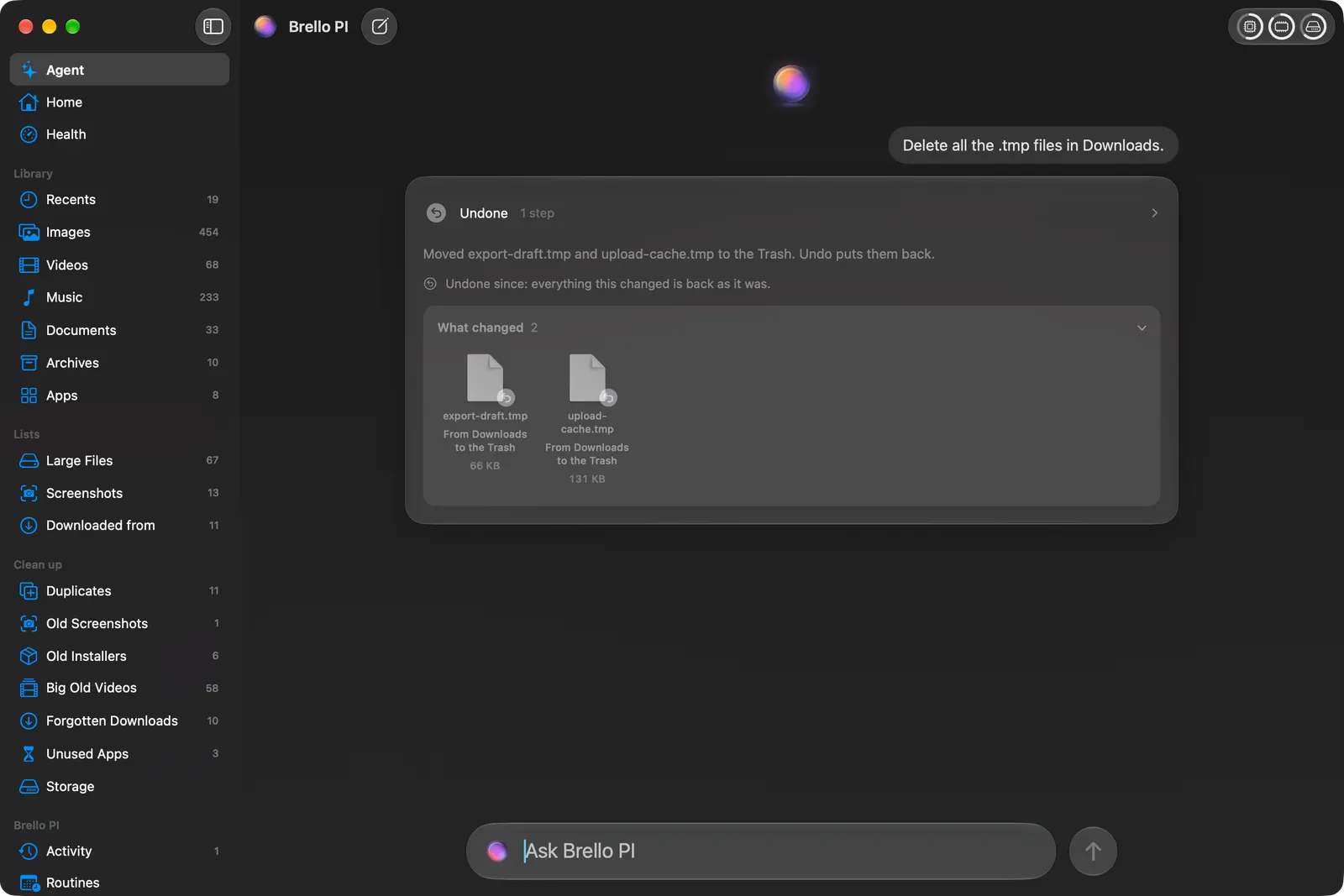
Undo is measured to the same standard as the change itself, on the disk. In the benchmark, “put back” means the folder is byte for byte what it was before the run, not that Undo reported success.
The benchmark
Brello PI’s benchmark is 65 tasks on made-up homes: files to move, copy, rename and set aside; documents to read, compare and summarize; receipts to turn into a report; research briefs; routines; and tasks on a made-up calendar, mailbox and notes. Each is scored by the state it leaves behind: what must be removed, what must be created, what a new file must say. Anything else that changed is a failure, however good the answer sounded.
On October 19, played three times each on Apple’s on-device model, every one of the 195 runs reached its goal, none removed or created anything it wasn’t asked to, and Undo restored the starting state exactly in all 138 runs that had changed something.
Wordings we hadn’t seen
A benchmark you tune on stops measuring anything. So on October 15, after fixing how Brello reads file requests, we wrote four sets of 21 new wordings, each written after the fixes before it and committed before its first run. A set’s first run is its measure; what it showed was fixed in general, never for its sentences, and then the next set was written.
Held-out wordings of file requests, first runs
Four sets of 21, written and committed before each first run, October 15, 2026
Figure 3 as a table
| Set of 21 | Done as asked | Changed nothing | Changed files |
|---|---|---|---|
| W, first run | 9 | 6 | 6 |
| X, first run | 15 | 4 | 2 |
| Y, first run | 14 | 3 | 4 |
| Z, first run | 11 | 8 | 2 |
| Z, after the rule | 11 | 10 | 0 |
The fourth set is the honest number: 11 of 21 done as asked. The ten it couldn’t do were phrasings its reader didn’t know, such as “the rest,” “the one before it” and “leaving … alone.” The rule we added didn’t make Brello understand them. It made Brello say so: for each of the ten it now answers with what it couldn’t tell, and changes nothing. A failure that changes nothing costs you a sentence. A failure that moves the wrong files costs you trust.
What can’t come back
- What you do outside Brello. Undo covers what Brello did. A file you delete in Finder is Finder’s.
- What is final by nature. Emptying the Trash, sleep, restart, shut down and log out. Each asks first and says it can’t be undone.
- The benchmark’s homes are made up. Real disks hold stranger things than any seed, and we expect real use to find failures these runs didn’t.
Notes and sources
- Runs on an iMac with Apple M4 and 32 GB of memory, running macOS 27.0. The benchmark: three trials of each task, with approvals answered as a person who said yes only to deletions they asked for.
- “Byte for byte” means the home folder after Undo has the same files, with the same contents, as before the run, checked by the benchmark, not by Brello.
- The held-out sets and their fixes are the same work as the one held-out number in Code first, model second.